Instagram Facebook Youtube linkedin

ARTIFICIAL INTELLIGENCE AND MACHINE LEARNING

ABOUT DEPARTMENT

Artificial Intelligence and Machine Learning is the scientific and practical approach to computation and its applications. A Computer Scientist specializes in the theory of computation and the design of computational systems.


Aim :

The department aims to develop professionally competent AIML engineers with strong fundamentals, practical skills, ethical values, and research orientation to meet industry, societal, and global technological needs.


Objectives :

  1. To develop strong technical and analytical competence in artificial intelligence, machine learning, data science, and computing fundamentals for solving complex engineering and real-world problems.
  2. To produce industry-ready and responsible AI professionals by providing hands-on experience, modern tools, deployment practices, and embedding ethics, sustainability, and societal responsibility in AI solutions.
  3. To foster innovation, research orientation, and lifelong learning by encouraging interdisciplinary projects, entrepreneurship, effective communication, teamwork, and continuous skill up gradation.

.


Career Oportunities :

  • Industry & Global Employment:
    AIML graduates can work as AI/ML Engineers, Data Scientists, Analytics and Machine Learning Engineers in national and international IT companies, product-based firms, startups, and R&D organizations across countries like India, USA, Europe, and Asia-Pacific.
  • Higher Studies & Research:
    Graduates can pursue MTech/MS/PhD in Artificial Intelligence, Machine Learning, Data Science, and related fields, leading to careers in research laboratories, academia, and innovation centre's worldwide.
  • Entrepreneurship & Public Sector:
    AIML students can establish AI-based start-ups, work as AI consultants, or serve in government, defence, smart city, and public sector projects applying intelligent solutions to societal and national challenges.


VISION & MISSION

Vision :

To emerge as a centre of excellence in Artificial Intelligence and Machine Learning education by nurturing innovative, ethical, and socially responsible engineers capable of transforming data into intelligent solutions for global and societal challenges.


Mission :

  1. To impart strong theoretical and practical foundations in Artificial Intelligence, Machine Learning, Data Science, and allied technologies through outcome-based education.
  2. To promote innovation and problem-solving skills by encouraging project-based learning, and real-world applications of intelligent systems.
  3. To foster ethical awareness and social responsibility in the development and deployment of AI-driven technologies.
  4. To cultivate lifelong learners and future leaders equipped with technical competence, communication skills, teamwork, and adaptability

POs, PEOs & PSOs

Program Educational Outcomes :

PEO 1: Graduates will apply fundamental principles of AI & ML to design and develop intelligent systems for real-world problems.

PEO 2: Graduates will succeed in professional careers, higher education, or entrepreneurship by continuously enhancing their technical and analytical skills.

PEO 3: Graduates will demonstrate ethical values, teamwork, leadership, and social responsibility while contributing to society and industry.


Program Outcomes :

PO 1 - Application of Engineering Knowledge: Apply knowledge of Engineering, management, mathematics and science for solving engineering problems. Analyze, plan and apply the acquired knowledge in basic sciences and mathematics in solving problems with technical, economic, environmental and social contexts.

PO 2 - Analysis of Problem: Ability to design and conduct experiments as well as to analyze and interpret experimental or collected data, simulate and fabricate circuits and systems, and make own projects utilizing the latest software tools and techniques. Design, build, and test analog & digital electronic systems for given specifications.

PO 3 - Design/development of solutions: Design a system, component, or process to meet the desired specifications, performance, and capabilities; compatible with health, safety, legal, societal, and environmental considerations.

PO 4 - Conduct investigations of complex problems: Use research-based knowledge and research methods including design of experiments, analysis and interpretation of data, and synthesis of the information to provide valid conclusions.

PO 5 - Modern tool usage: Create, select, and apply appropriate techniques, resources, and modern engineering and IT tools including prediction and modeling to complex engineering activities with an understanding of the limitations.

PO 6 - The Engineer and Society: Apply reasoning informed by contextual knowledge to assess societal, health, safety, legal, and cultural issues and the consequent responsibilities relevant to the professional engineering practice.

PO 7 - Environment and Sustainability: Understand and correctly interpret the impact of engineering solutions in global, societal, and environmental contexts and demonstrate the knowledge of a need for sustainable development.

PO 8 - Ethics: Understand ethics of life and professions and abide by them.

PO 9 - Individual and Team-work: Communicate effectively, demonstrate leadership qualities, and exhibit professional conduct in their career. Work with a multi-disciplinary team, and appreciate the role of a leader, leadership principles, and attitudes conducive to effective professional practice of Engineering.

PO 10 - Communication: Communicate and present effectively both orally and in writing, such as being able to comprehend and write effective reports and design documentation, make effective presentations and give and receive clear instructions.

PO 11 - Project management and finance: Demonstrate knowledge and understanding of the engineering finance and management principles as a member and leader in a team to manage projects in multi-disciplinary environments. Apply relevant shop practices in compliance with safety policies and current regulations for engineering workplaces.

PO 12 - Life-long learning: Engage in life-long learning, demonstrate knowledge and understanding of contemporary and emerging issues relevant to their domain, demonstrate knowledge and understanding of business practices and principles of management, and understand their limitations. Develop awareness of legal consequences of engineering solutions.


PSO's :

PSO 1: Apply knowledge of mathematics, statistics, computing fundamentals, artificial intelligence and machine learning to analyse, model and solve complex engineering problems using appropriate algorithms, tools and techniques.

PSO 2: Design, develop, test and deploy AI-based systems and applications by integrating data engineering, machine learning models, software engineering practices, and modern tools for scalable and reliable solutions.

PSO 3: Evaluate and implement responsible AI solutions by considering ethics, privacy, security, societal impact, environmental sustainability, legal constraints, and professional responsibilities while addressing real-world and regional challenges.
PSO 4: Conduct investigations and research in AI/ML domains, communicate effectively, work in multidisciplinary teams, demonstrate leadership and entrepreneurship, and engage in lifelong learning to adapt to rapidly evolving technologies.


MEET THE HoD

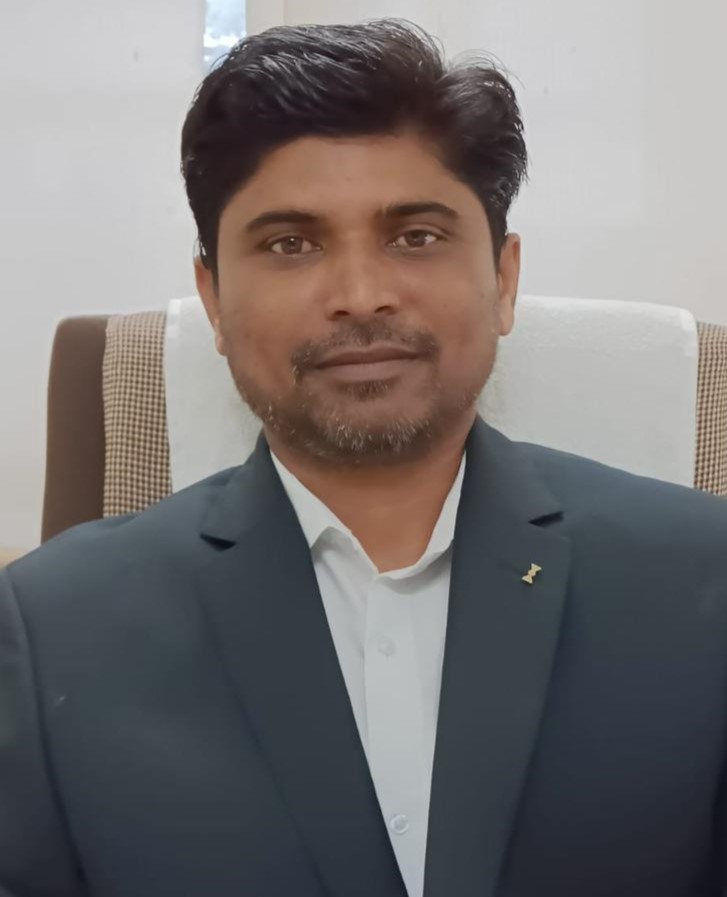
Prof. S.D.Gavande


Head Of Department:-Artificial Intelligence And Machine Learning
Qualification:- ME(Comp. Engg)
Email id :- hodaiml@iceemabad.com


Prof. S.D. Gavande is an experienced academician with over 9 years of teaching and leadership experience in Computer Engineering. She has served as Head of Department and has actively contributed to NBA and NAAC accreditation processes. Her expertise includes Discrete Mathematics, Operating Systems, Programming Languages, and emerging computing technologies. She has published several research papers in reputed national and international journals. has also published a book titled _"Introduction to Programming Languages and C Fundamentals." As HOD of AIML, she is committed to academic excellence, outcome-based education, and student-centric learning.

FACULTY

Sr. No. Name Designation Qualification Experience (Years) Contact No. Email ID Photograph
1 Prof. S. D. Gavande HOD ME (Computer Engineering) 9 9552701626 gavandesavita@gmail.com
2 Dr. Sarika M. Chavan Professor B.E, M.E, Ph.D. (Computer Engineering) 20 - sarikasolanke601@gmail.com
3 Prof. S. A. Chechare Assistant Professor M.Tech (CSE) 8 7385897002 sujataiceem@gmail.com
4 Prof. A. P. Wagh Assistant Professor M.Tech (CSE) 3 9284183388 wagh.ashvini2@gmail.com
5 Prof. K. P. Chavan Assistant Professor M.Tech (CSE) 9 9767574308 chavankp143@gmail.com
Prof. S. D. Gavande
Prof. S. D. Gavande
HOD
Dr. Sarika M. Chavan
Professor
Prof. S. A. Chechare
Assistant Professor
Prof. A. P. Wagh
Prof. A. P. Wagh
Assistant Professor
Prof. K. P. Chavan
Prof. K. P. Chavan
Assistant Professor

ACHIEVEMENTS

Patents Registered: 

  • Zafar Ul Hasan: Innovation Patent on "A Smart Cooking Device and its process" by IP Australia, Patent No: 2021106717, Validity: 24 August 2029
  • Zafar Ul Hasan: Published and in process "Bio-telemetry and the Internet of Things based Intelligent Healthcare Monitoring System", by office of Controller General of Patent, Designs & Trade Marks, Govt. of India, No: 202241064692, date of Pub: 25/11/2022

Resource Person: 

  • Zafar Ul Hasan: Delivered lecture on "Introduction to Marketing Management" held on 20th August 2022 at MCED Jalna Unit, Jalna.
  • Zafar Ul Hasan: Delivered lecture on "Cash Flow Management in a Business" held on 13th September 2022 at MCED Aurangabad Unit, Aurangabad.
  • Zafar Ul Hasan: Delivered lecture on "Making of Project Report" held on 29th October 2022 at MCED Aurangabad Unit, Aurangabad.
  • Zafar Ul Hasan: Delivered lecture on "Soft Skills" held on 30th November 2022 at MCED Aurangabad Unit, Aurangabad.
  • Zafar Ul Hasan: Delivered lecture on "Strategy for Digital Marketing" held on 31st December 2022 at MCED Khuldabad Unit, Aurangabad.

COMMITTEE

Program Assessment Committee (PAC) :

Sr. No. Name of Faculty Designation Position
1 Prof. S. D. Gavande HOD AIML Program Coordinator
2 Dr. Sarika M. Chavan Professor Program Co-Coordinator
3 Prof. K. P. Chavan Assistant Professor Member
4 Prof. S. A. Chechare Assistant Professor Member
5 Prof. A. P. Wagh Assistant Professor Member

Departmental Advisory (DAB) :

Sr. No. Name of Faculty Designation Position
1 Dr. R. R. Deshmukh Director Advisor
2 Dr. C. S. Padmavat Campus Director Advisor
3 Prof. H. L. Jadhav Vice Principal & HOD EEE Advisor
4 Prof. A. B. Humbe Assistant Professor Advisor
5 Mr. Nitin S. Magar HOD Program Coordinator and PAC Coordinator
6 Mr. Zafar Ul Hasan Assistant Professor Co-Program Coordinator
7 Prof. S. D. Gavande HOD AIML Program Coordinator
8 Dr. Sarika M. Chavan Professor Co-Program Coordinator
9 Prof. K. P. Chavan Assistant Professor Member
10 Prof. S. A. Chechare Assistant Professor Member
11 Prof. A. P. Wagh Assistant Professor Member

MoU's

LABORATORIES

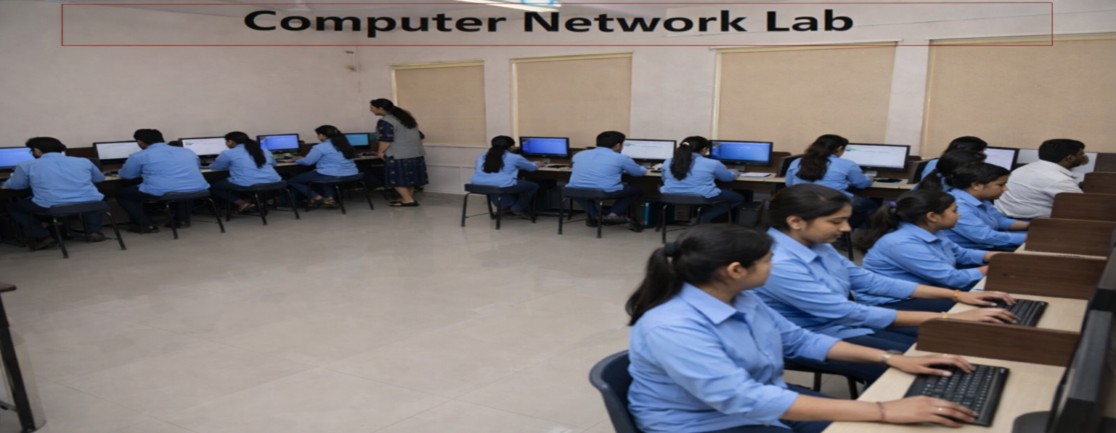
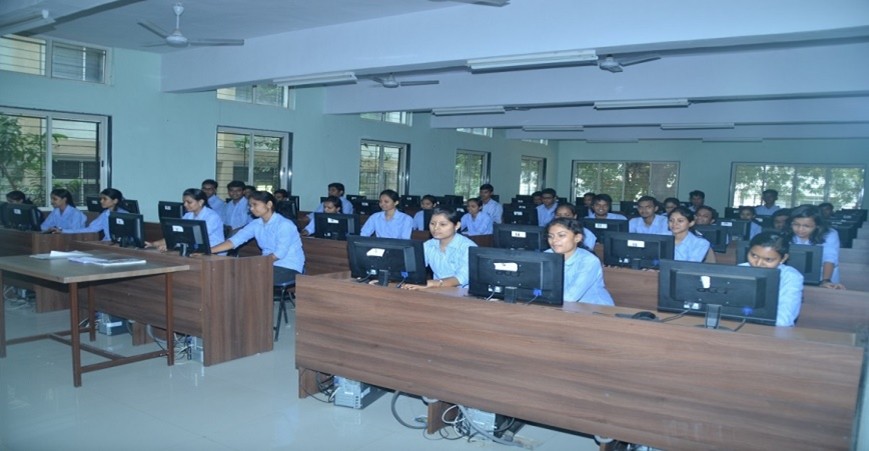
1. Computer Network Lab
Field Details
Laboratory Name Computer Network Lab
Lab In-charge Prof. K. P. Chavan
Supporting Staff N.A.
Year of Establishment N.A.
Lab Location (Room No. / Block) Computer Network Lab
Computer Network Lab
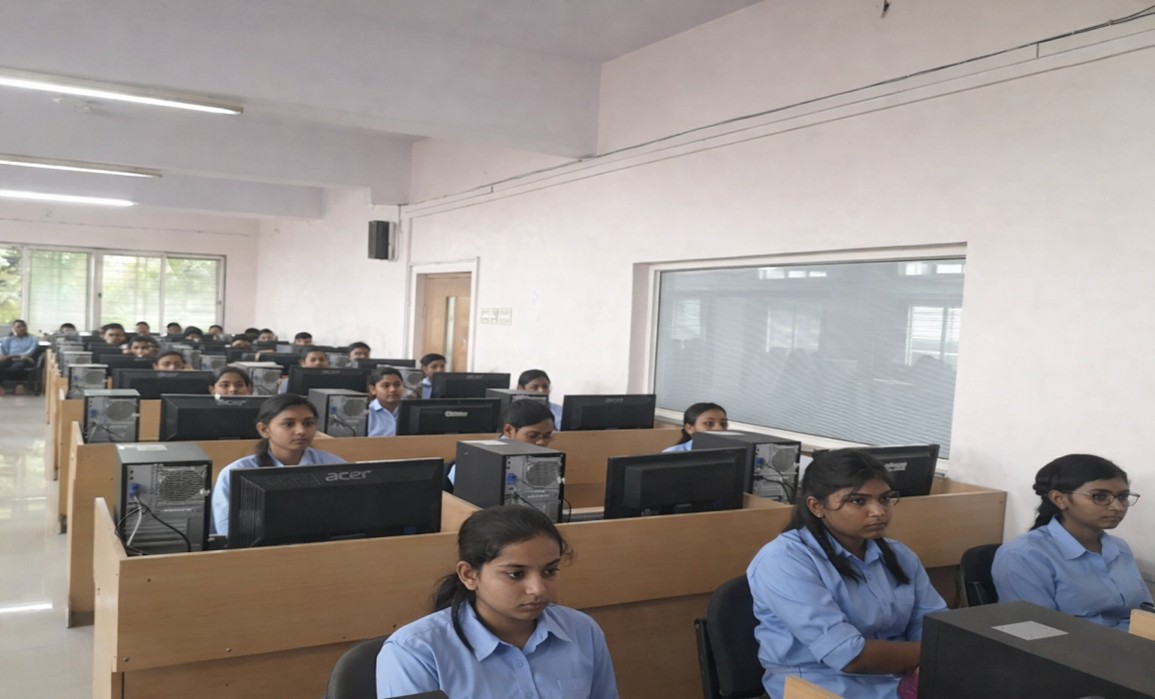
2. Language Lab (CSE)
Field Details
Laboratory Name Language Lab (CSE)
Lab In-charge Prof. S.A. Chechare
Supporting Staff N.A.
Year of Establishment N.A.
Lab Location (Room No. / Block) Language Lab (CSE)
Language Lab (CSE)
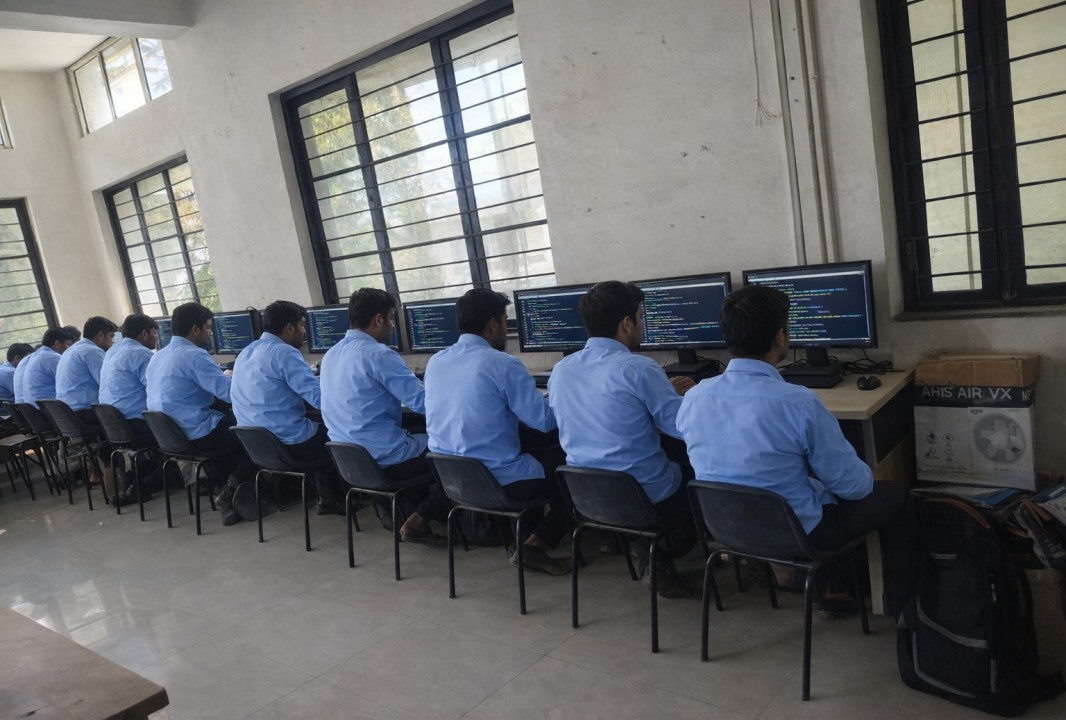
3. Software Development Lab
Field Details
Laboratory Name Software Development Lab
Lab In-charge Prof. A.S. Wagh
Supporting Staff N.A.
Year of Establishment N.A.
Lab Location (Room No. / Block) Software Development Lab
Software Development Lab

COURSE INSTRUCTIONAL METHOD

  • Artificial Neural Networks
  • Business Economics and Financial Analysis
  • Cloud Computing
  • Compiler Design
  • Computer Forensics
  • Computer Organization
  • Cryptography & Network Security
  • Data Communications & Computer Networks
  • Data structures
  • Data Warehousing & Data Mining
  • Database Management System
  • Design & Analysis of Algorithms
  • Dynamic Programming
  • Formal Languages and Automata Theory
  • Intellectual Property Rights
  • Linux Programming
  • OOP through Java
  • Operating System
  • Programming and Problem Solving
  • Software Project Management
  • Web Technology

CERTIFICATE COURSES

Sr. No. Academic Year Semester Class & Branch No. of Students Certification / Value Added Course Name Course Duration
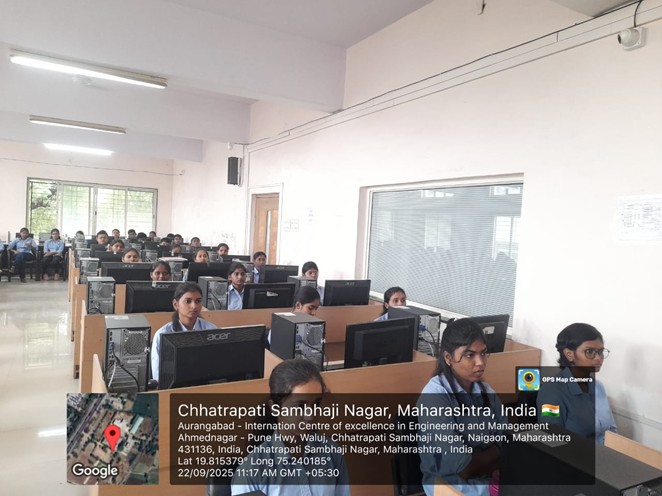
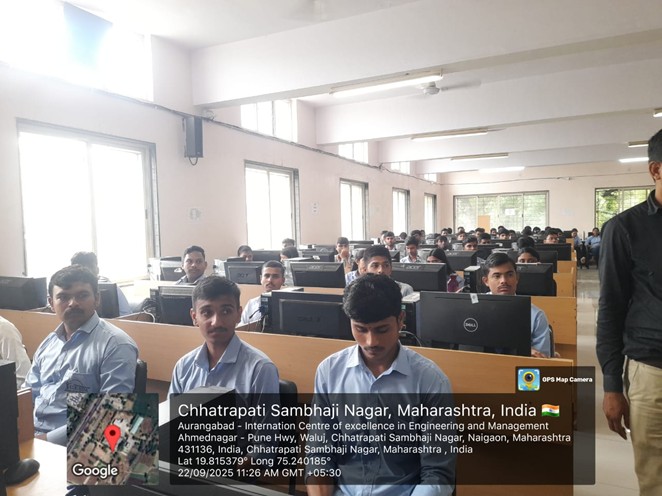
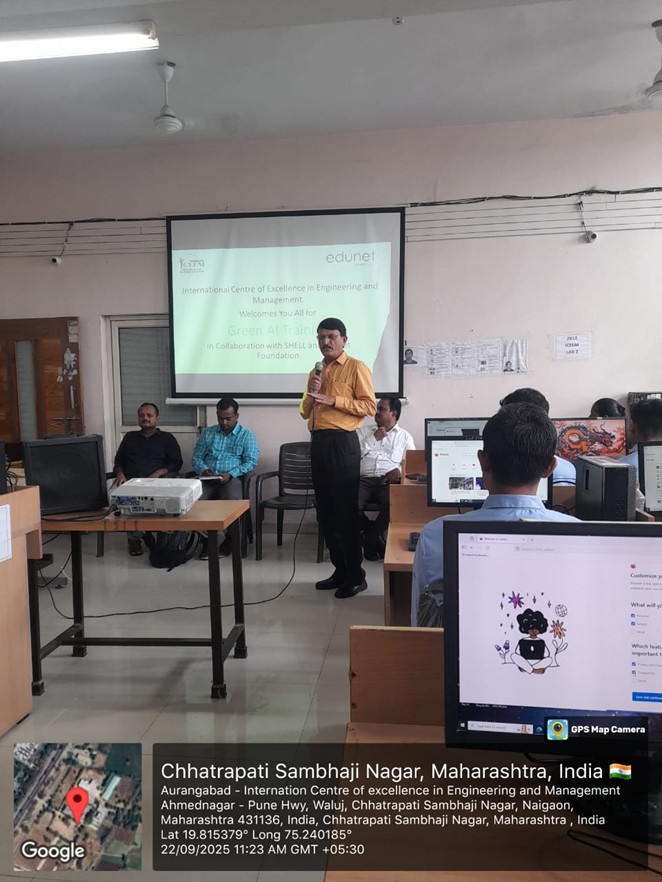
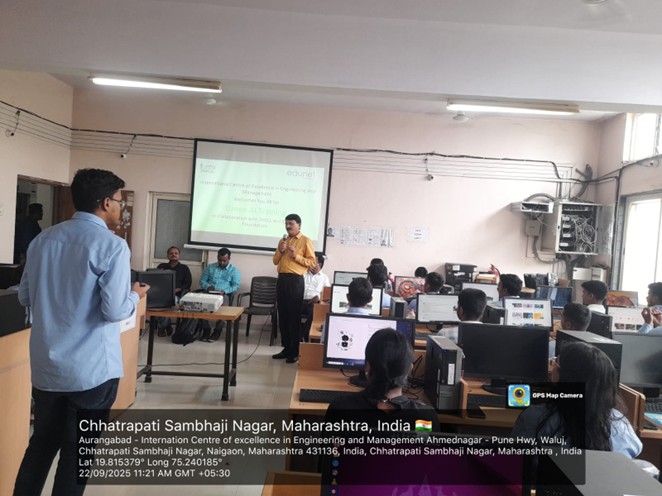
1 A.Y. 2025-26 SEM-I SE AIML 65 Green AI 22/09/2025 to 27/09/2025
2 A.Y. 2025-26 SEM-I SE AIML 65 tcsION -
3 A.Y. 2025-26 SEM-I TE AIML 40 tcsION -
4 A.Y. 2025-26 SEM-I TE AIML 40 Hashgraph Developers Course (Blockchain) 08/09/2025 to 10/09/2025
5 A.Y. 2024-25 SEM-I SE AIML 45 Green AI 6 Days

Certificate courses in Artificial Intelligence (AI) and Machine Learning (ML) offer comprehensive training in these cutting-edge fields. These courses cover a range of topics, including the fundamentals of AI and ML, programming languages like Python, tools such as TensorFlow and PyTorch, data analysis and visualization, model development, deep learning, real-world applications, and ethical considerations. Participants gain practical skills in data preprocessing, feature engineering, model evaluation, and creating training, and fine-tuning machine learning models. They also explore neural networks, deep learning architectures, and applications in industries like healthcare, finance, and autonomous vehicles.

Objective Of Certification Course :

The objectives of a certification course are multifaceted and geared toward enhancing participants' knowledge, skills, and career prospects:

  1. Skill Enhancement: The course aims to provide participants with specialized skills and practical knowledge in a specific domain, empowering them to excel in their chosen field.
  1. Industry Relevance: By focusing on current industry trends and best practices, the course ensures that participants acquire skills that are directly applicable and in demand in their respective sectors.
  1. Professional Validation: Completion of the certification offers a recognized credential that validates participants' expertise, boosting their credibility and employability in the eyes of employers.
  1. Career Advancement: The course enables individuals to unlock new career opportunities, promotions, and salary increases by equipping them with advanced skills and knowledge.
  1. Lifelong Learning: Beyond immediate career benefits, the course fosters a mindset of continuous learning, enabling participants to stay updated with evolving technologies and remain competitive in a dynamic job market.

Scope of the Course :

The scope of a certification course is wide-ranging and holds significant potential for personal and professional development:

  1. Skill Diversification: Certification courses offer the opportunity to acquire new skills or deepen existing ones, enabling individuals to explore diverse career paths and industries.
  1. Career Advancement: A certified skill set enhances employability and opens doors to higher-level positions, promotions, and increased earning potential.
  1. Industry Relevance: Certification equips individuals with up-to-date knowledge and skills aligned with industry trends, making them valuable assets to employers and staying competitive in the job market.
  1. Entrepreneurship: Certified individuals can leverage their expertise to launch startups or independent ventures, applying their skills to create innovative products or services.
  1. Networking: Certification programs often provide a platform to connect with peers,mentors, and professionals in the field, expanding one's professional network.

VALUE ADDED COURSES

Value-added courses in Artificial Intelligence and Machine Learning (AIML) provide students with specialized knowledge that enriches their educational journey. These courses delve into advanced concepts like neural networks, natural language processing, and data analytics, fostering a deep understanding of complex AI-driven systems. By aligning with the latest
industry trends, AIML courses enhance employability, enabling graduates to tackle real-world challenges with practical expertise. Recognized certifications validate proficiency, opening doors to career advancement and opportunities for innovation in fields ranging from healthcare and finance to e-commerce and autonomous systems.


Objective Of Course : 

1. Expertise Enhancement: Deepen AI and ML knowledge.
2. Industry Relevance: Align with cutting-edge tech demands.
3. Skills Practical: Acquire data-driven problem-solving abilities.
4. Certification Validation: Showcase AI and ML proficiency.
5. Career Advancement: Enable growth in diverse sectors.


Scope Of Course :

1. Broad Topics: Covers AI and ML applications extensively.
2. Emerging Fields: Includes areas like NLP, computer vision, and robotics.
3. Versatile Roles: Opens doors to data science, AI development, and more.
4. Industry Demand: Meets growing needs in tech-driven sectors.
5. Innovation Potential: Prepares for creating AI-driven solutions.

VALUE ADDED COURSES

Value-added courses in Artificial Intelligence and Machine Learning (AIML) provide students with specialized knowledge that enriches their educational journey. These courses delve into advanced concepts like neural networks, natural language processing, and data analytics, fostering a deep understanding of complex AI-driven systems. By aligning with the latest
industry trends, AIML courses enhance employability, enabling graduates to tackle real-world challenges with practical expertise. Recognized certifications validate proficiency, opening doors to career advancement and opportunities for innovation in fields ranging from healthcare and finance to e-commerce and autonomous systems.


Objective Of Course : 

1. Expertise Enhancement: Deepen AI and ML knowledge.
2. Industry Relevance: Align with cutting-edge tech demands.
3. Skills Practical: Acquire data-driven problem-solving abilities.
4. Certification Validation: Showcase AI and ML proficiency.
5. Career Advancement: Enable growth in diverse sectors.


Scope Of Course :

1. Broad Topics: Covers AI and ML applications extensively.
2. Emerging Fields: Includes areas like NLP, computer vision, and robotics.
3. Versatile Roles: Opens doors to data science, AI development, and more.
4. Industry Demand: Meets growing needs in tech-driven sectors.
5. Innovation Potential: Prepares for creating AI-driven solutions.

BEST PRACTICES

  • Mentor–Mentee Scheme
  • Continuous Assessment
  • Well Equipped Labs
  • Well Qualified Staff
  • Guest Lectures
  • Smart Classroom
  • Use of LMS, e-resources & ICT tools
  • Regular Feedback from Stakeholders
  • Tools & Certifications
    • tcsION
    • NPTEL
    • Green AI
  • Virtual Environments
    • Providing V-Lab for Students (IIT Bombay)
  • Aptitude, Communication Skills & Soft Skills Training
  • Industrial Visits, Mini & Minor Projects

EVENTS & ACTIVITIES

Sr. No. Academic Year Event / Seminar / Expert Talk / Activity Title Expert / Guest Name Date
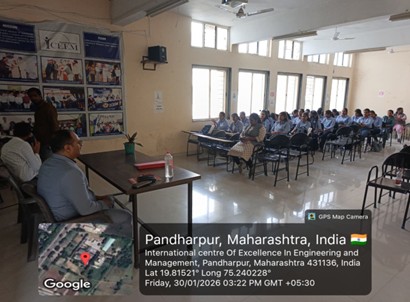
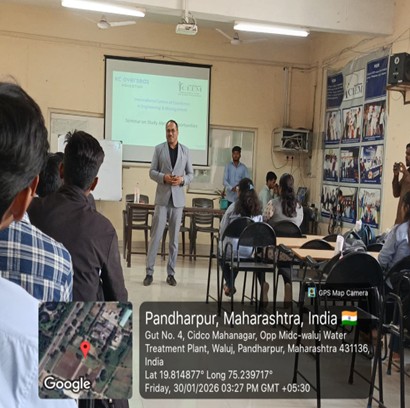
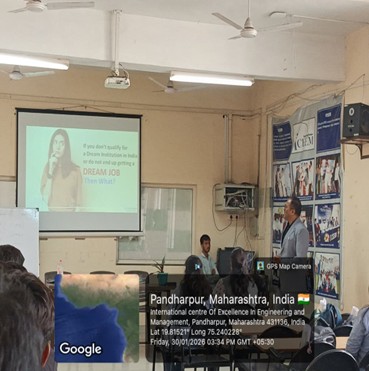
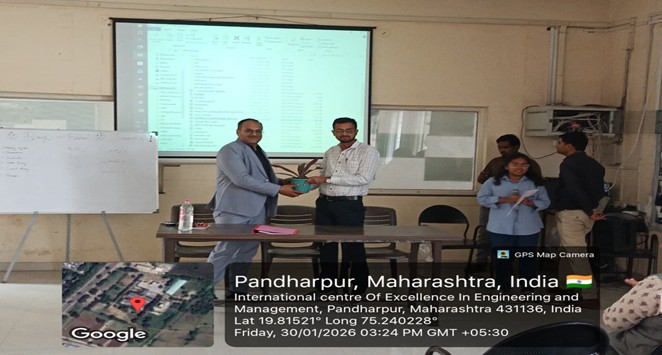
1 2025-26 Comprehensive Overview – Study Abroad of Higher Education Options Available Mr. Mahesh Shisode,
Lead – Business Development,
KC Overseas Education
30/01/2026
2 2025-26 Expert Talk on Effective Communication and Interview Skills for Career Success Ms. Renuka Kale,
Assistant Professor,
MIT College
03/02/2026
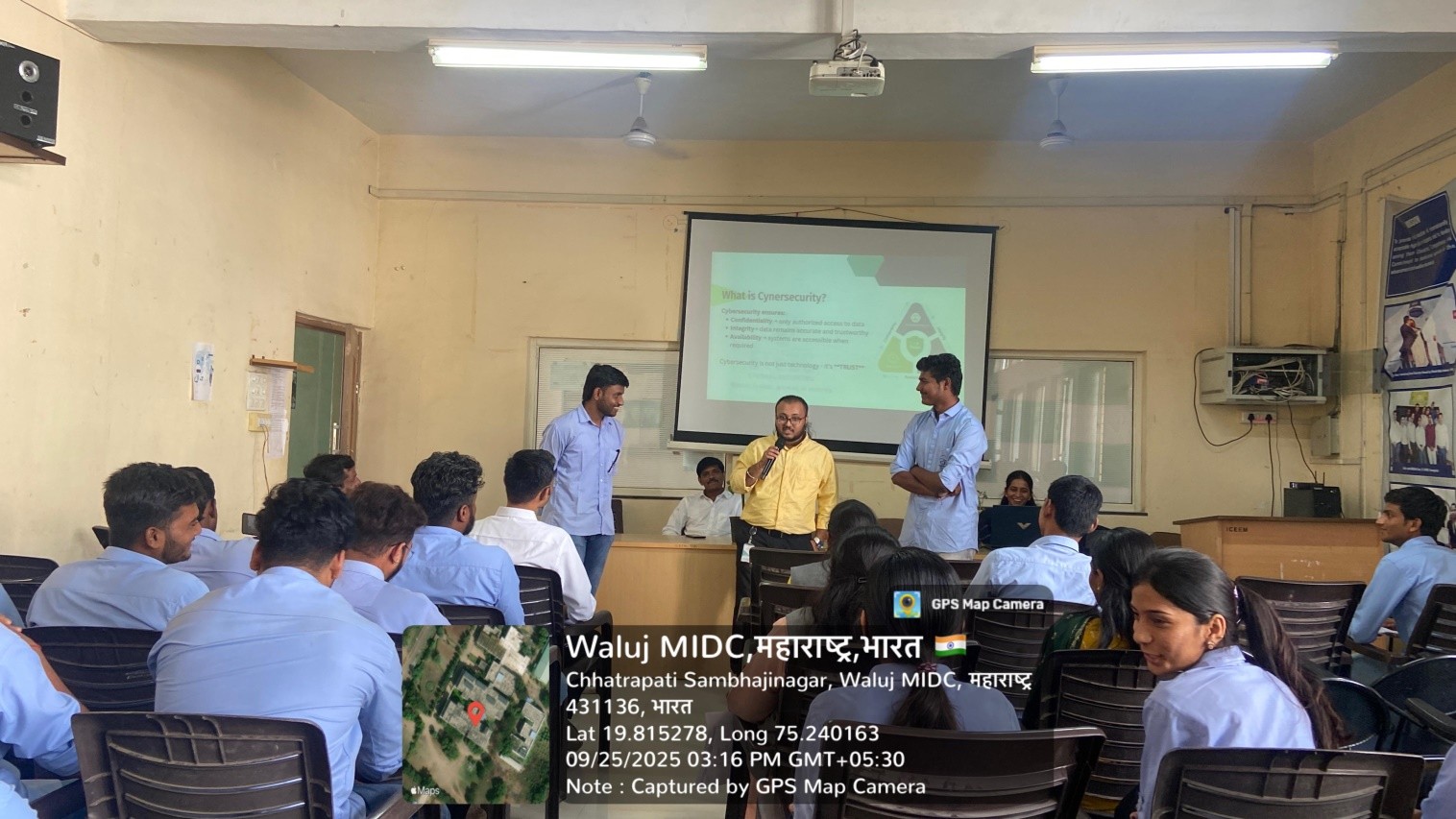
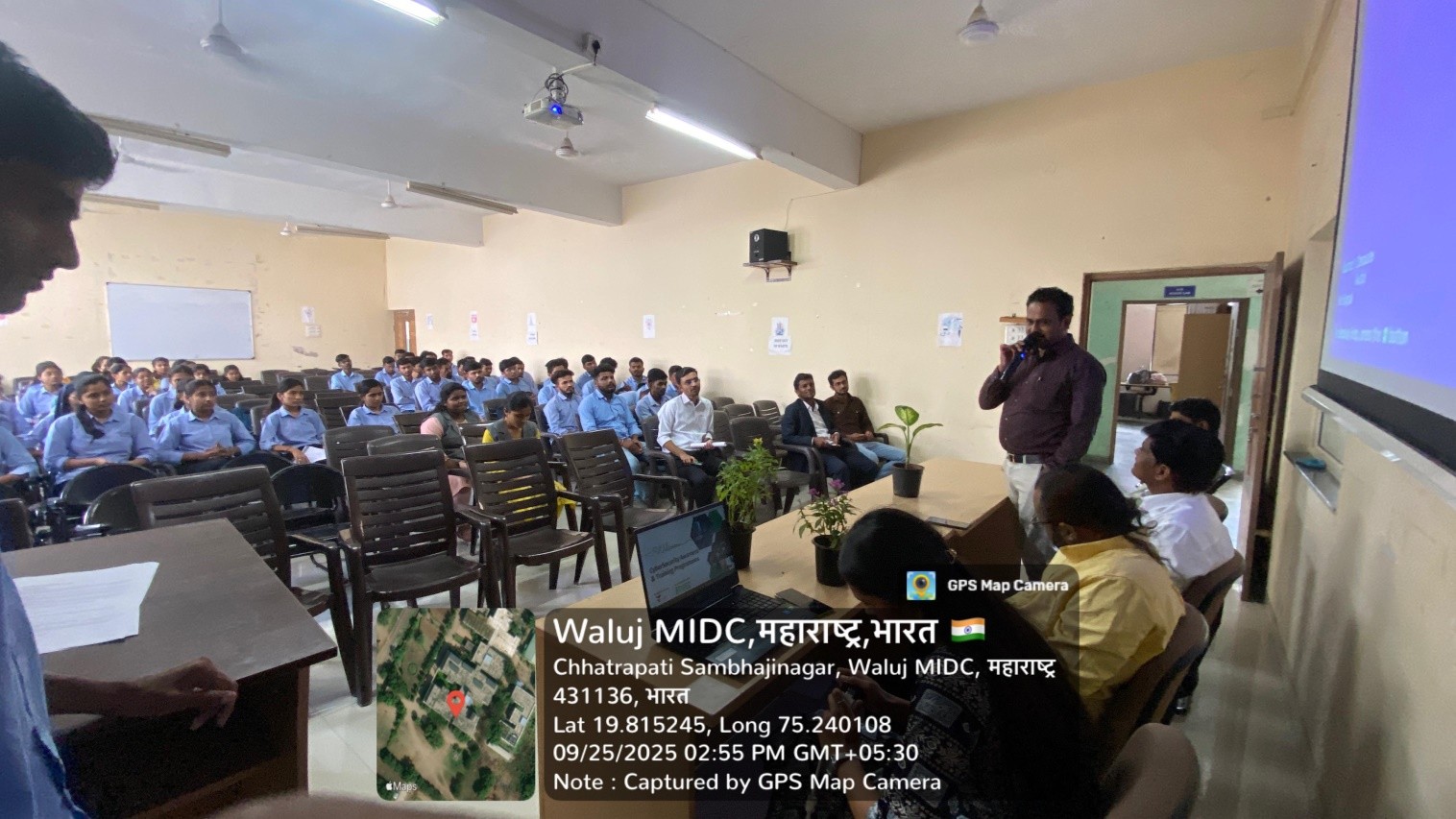
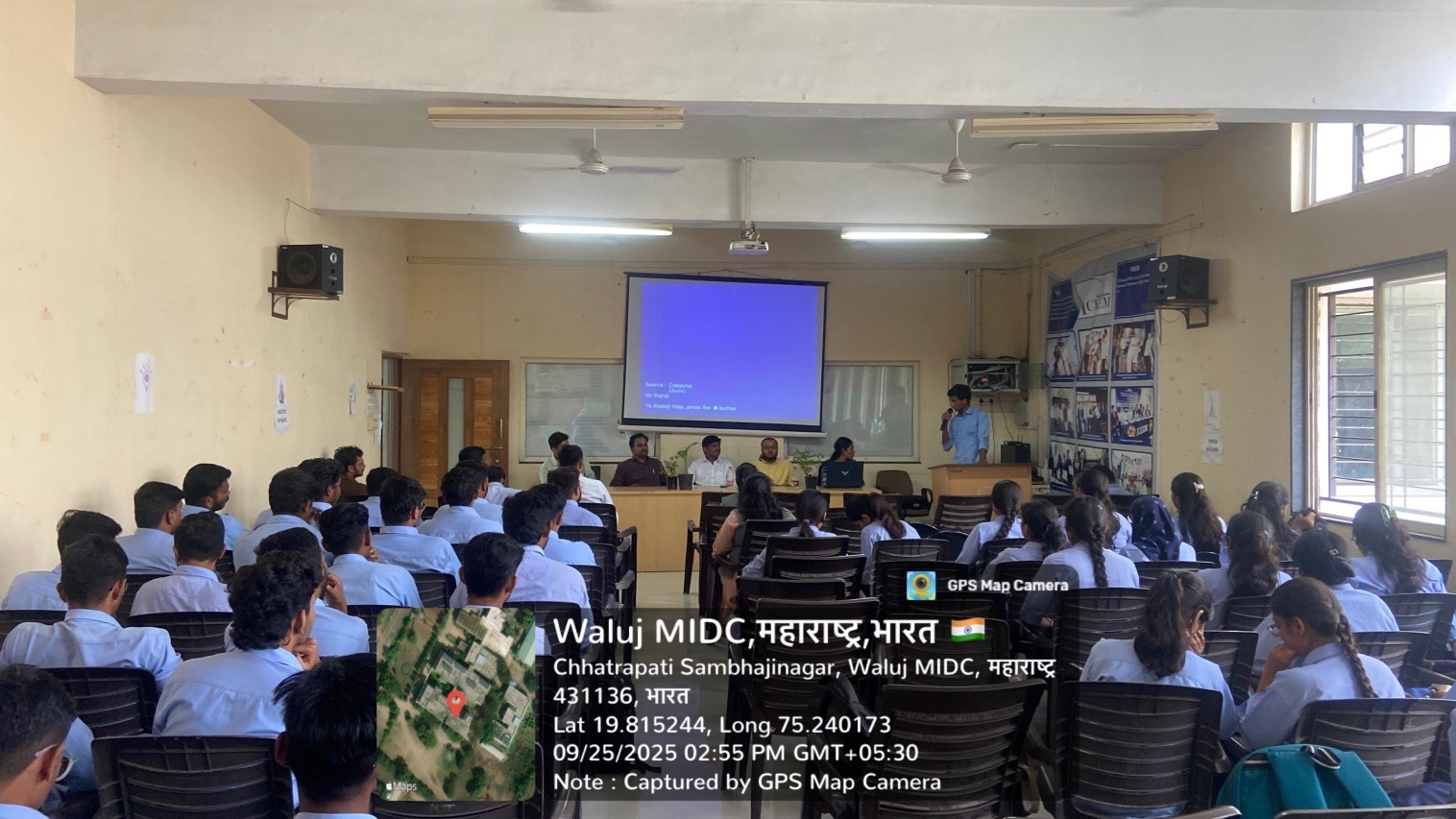
3 2025-26 Expert Talk on Cyber Security Mr. Atharva Joshi 25/09/2025
4 2025-26 Expert Talk on Value Based Education Mr. Datta Rokade 28/08/2025
5 2025-26 Expert Talk on Introduction to Cloud Computing Prof. Nitin Magar 08/08/2025
6 2025-26 Expert Talk on Blockchain Mr. Sunil Yedavalli 08/09/2025
7 2025-26 Expert Talk on IPR Filing and Publication Dr. S. N. Kakarwal 16/09/2025
8 2025-26 Expert Talk on Career Planning for Higher Salary Package Dr. C. S. Padmavat 16/09/2025
9 2025-26 Workshop on Green AI Mr. Jitendra Ratod 22/09/2025 to 27/09/2025
10 2024-25 Expert Talk on AI Mr. Swapnili Naik 05/02/2025
11 2024-25 Workshop on AI Mr. Swapnili Naik 03/02/2025 to 07/02/2025

ACTIVITIES

No Content Added Yet

CONTACT

Prof. N.S. Magar

HoD AIML ICEEM

Drop us a message

PAPERS PUBLISHED

Sr. No. Title of Paper Author(s) Journal / Conference Name ISSN No. DOI Volume / Issue / Page No. Year Publisher Indexed In
1 Energy Conservation Protocol in Wireless Sensor Network Prof. S. D. Gavande IJARESM 2455-6211 - 978–984 2025 IJARESM UGC (8.536)
2 Energy Conservation Protocol in Wireless Sensor Network S. D. Gavande IJIRCCE 2320-9801 / 2320-9798 - Vol. 4, Issue 1 2016 IJIRCCE 1.513
3 Energy Conservation Protocol Works in Physical Layer of WSN S. D. Gavande IOSR-JMCE 2278-1684 / 2320-334X - PP 23–28 2014 IOSR-JMCE -
4 Energy Conservation Protocol using Sleep Scheduling in WSN S. D. Gavande IJCA ISBN: 973-93-80885-81-5 - Vol.114, No.14, PP 23–25 2015 IJCA -
5 Iris Biometric for Person Identification using Phase-based Image Matching Dr. Sarika M. Chavan IEEE – International Conference (DBAMU) - - - 2013 IEEE -
6 Comparison of Feature Extraction Dr. Sarika M. Chavan IJMR - - Vol.1, Issue 12 2013 IJMR -
7 Lossy Compression Using Haar Wavelet Transform Dr. Sarika M. Chavan IJMR - - Vol.1, Issue 12 2013 IJMR -
8 Biometrics Iris Recognition System – Secured Authentication Dr. Sarika M. Chavan IEEE – Sustainable Global Development - - - 2016 IEEE -
9 Survey on Techniques for Improving User Navigation Dr. Sarika M. Chavan IJERT - - Vol.4, Issue 08 2015 IJERT -
10 The Survey of Complications in Iris Recognition Dr. Sarika M. Chavan IJIRSET 2395-0056 / 2395-0072 - Vol.5, Issue 10 2016 IJIRSET -
11 A Survey of Dual Sentiment Analysis Dr. Sarika M. Chavan IJARCCE - - Vol.5, Issue 6 2016 IJARCCE -
12 A Privacy Preserving QoS Prediction Framework Dr. Sarika M. Chavan IRJET 2395-0056 / 2395-0072 - - - IRJET -
13 Analysis of Authentication Method Dr. Sarika M. Chavan IJSR - - Vol.5, Issue 7 2016 IJSR -
14 Web Service Recommender System Dr. Sarika M. Chavan IJREAM 2454-9150 - Vol.02, Issue 12 2017 IJREAM -
15 Security and Privacy Implications of Alexa Skills S. R. Salve JETIR 2349-5162 - Vol.12, Issue 8 2025 JETIR 7.95
16 Comparative Analysis of Data Mining Techniques S. R. Salve IJEDR 2321-9939 - Vol.13, Issue 4 2025 IJEDR 9.37
17 Review of Stock Price Prediction Techniques Using ML A. P. Wagh IJRASET 2321-9653 - Vol.13, Issue 4 2025 IJRASET 7.894
18 Sophisticated ML Approach for Stock Price Prediction A. P. Wagh JOT 1012-3407 - Vol.13, Issue 6 2025 JOT 5.1
19 Student Teacher Performance Prediction Using ML K. P. Chavan IJIRCCE 2320-9801 - Vol.13, Issue 4 2025 IJIRCCE 8.7
20 Personality Prediction Based on OCEAN Model S. A. Chechare IJSRD 2321-0613 - Vol.13, Issue 11 2026 IJSRD 4.396

Workshops / STTP / FDP

Sr. No. Name of Faculty Type (Workshop / STTP / FDP) Title Organized By Date(s) Role Remarks
1 S. D. Gavande Expert Talk How to Write Research Paper ICEEM 21/07/2025 Attended
Conference Emerging Trends in Research Methodology in Higher Education System JAT, Malegaon 03/02/2025 Participant
FDP UHV-II CSMSS, Ch. Sambhajinagar 07/08/2025 - 14/08/2025 Participant
FDP Faculty Enrichment for Innovation-Led Academic Transformation through AMIL & Data Analytics Chitkara University, Himachal Pradesh 22/07/2025 - 28/07/2025 Participant
2 S. A. Chechare FDP Generative AI & Agentic AI CSE Dept., Bangalore Institute of Technology 23/09/2025 Participant
FDP Generative AI & LLM iBase Electrosoft LLP 09/11/2025 Participant
Expert Talk How to Write Research Papers ICEEM 21/07/2025 Attended
Workshop NPTEL CSMSS 24/05/2025 Attended
FDP Data Science & Business Analytics IIBM, Patna 02/12/2025 Participant
FDP Coverage of AI & Data Science (SDGs) CDS Dept., VIT Pune 16/12/2025 Participant
3 S. R. Salve FDP Generative AI & LLM iBase Electrosoft LLP 09/11/2025 Participant
FDP AI Tools Brainovision Solutions India Pvt. Ltd. 17/02/2025 Participant
4 P. R. Devkar FDP Coverage of AI & Data Science (SDGs) CDS Dept., VIT Pune 16/12/2025 Participant
Expert Talk How to Write Research Papers ICEEM 21/07/2025 Attended
5 K. P. Chavan Workshop ML Based Prediction of Educational Performance NCISET (CSMSS) 24/06/2025 Attended
FDP Blockchain Technology SR University 08/01/2024 Participant
Expert Talk How to Write Research Papers ICEEM 21/07/2025 Attended
FDP GEN AI CBIT 08/09/2025 Participant

ACADEMIC PROGRAMS

Sr. No. Program Name Level (UG / PG / PhD) Duration Intake Affiliated University Accreditation / Approval Year of Starting Curriculum Link (PDF / URL)
1 AIML UG 4 Years Current:-90 Proposed :-120 Dr. BAMU - 2023

Industrial Visits

Sr. No. Academic Year Name of Industry / Organization Visited Date of Visit
1 2025-26 Sewage Water Treatment Plant 10/10/2025